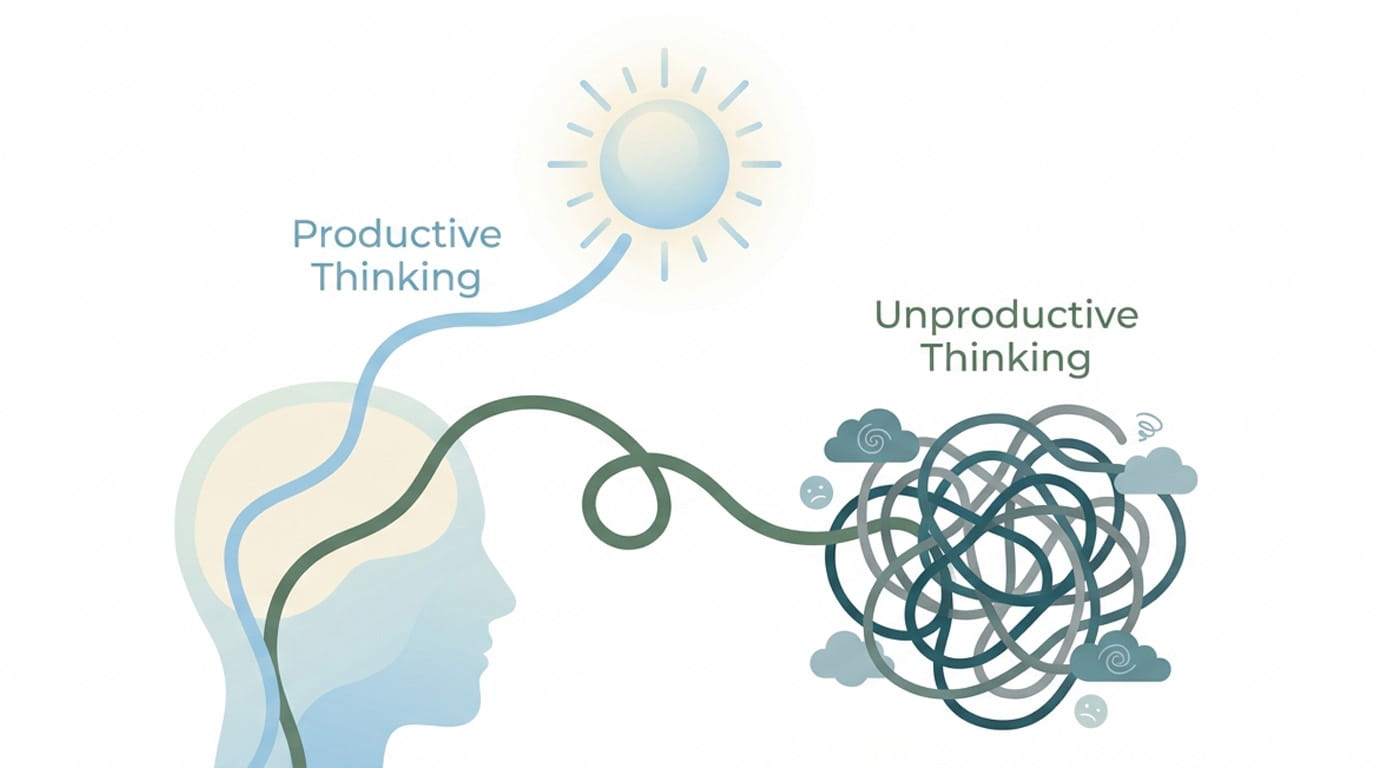
A lot of people develop the habit of analyzing every thought that pops into their heads.
But now that you understand the mind’s negativity bias, you also understand this:
Your mind is not trying to scare you. It’s trying to warn you of possible problems to protect you.
Ever feel like you’re arguing with yourself in your own head?
You’re not imagining it – there are two systems involved:
CONSCIOUS MIND
– aware of thoughts and feelings
– can choose what to focus on
– has decision-making power
SUBCONSCIOUS MIND
– automatic, habitual, instinctive reactions
– driven by survival and comfort
– always speaks first
The subconscious works fast. It pulls old experiences + assumptions + negativity bias, then throws you a possibility.
Your conscious mind chooses whether to engage with it.
Examples:
You see ice cream in a store…
– Subconscious: “Buy it! It always makes you feel good. Yummy!”
– Conscious: “I’ve already had one today. Not doing that.”
Heart starts pounding…
– Subconscious: “Heart failure! Get help! We’re dying!”
– Conscious: “I know my heart is healthy. It’s just adrenaline. Leave it alone.”
Someone doesn’t text back…
– Subconscious: “I knew it, they hate me.”
– Conscious: “I have no idea what’s happening on their end. Let it be – they might reply later.”
You can’t directly control the subconscious – but you CAN train it by using your conscious mind correctly.
And the first step is learning the difference between:
✅ Productive thinking
❌ Unproductive thinking
PRODUCTIVE THINKING
Productive thinking is quick, practical, and leads either to a solution that you can start working on right now (or in the near future) or acceptance of the fact that there’s no solution in the current moment – relief follows.
– You notice a problem
– Your mind gives you a helpful option
– You either take action or let it go ➜ Pressure drops
Examples:
Trash stinks? ➜ Take it out
Headache? ➜ Take medication
No milk? ➜ Go buy milk
Tooth hurts? ➜ Call dentist
Want to learn a language? ➜ Try an app
Might rain? ➜ Bring umbrella
Even productive thinking starts from resistance – the brain wants to fix discomfort – but it doesn’t keep you stuck in the resistance.
You solve what can be solved now or you accept what can’t be solved now, and move on.
If there is no action possible and you stay in the problem anyway?
➜ You slide into unproductive thinking
UNPRODUCTIVE THINKING
This is thinking that keeps you in long-term resistance, increasing stress and inner pressure.
It happens when:
A problem has no solution right now, but you still try to think your way into relief.
You don’t move on – so the discomfort grows.
Example 1:
A stranger accuses you unfairly and you argue.
You feel anger, embarrassment, tension – completely normal.
✅ Productive thinking:
“That sucked, but it’s done. I can’t change it. Moving on.”
Relief comes because you stop feeding the memory.
❌ Unproductive thinking:
Hours or days later you still replay the argument, invent better comebacks, tell everyone about it…
You keep the past alive and keep triggering the same feelings – even though nothing is happening anymore.
Example 2:
Someone in your family gets diagnosed with cancer and you think: “What if I get cancer too?”
You feel fear, dread, helplessness – completely normal.
✅ Productive thinking:
“I’m scared. Anyone would be. But I can’t predict the future.”
You don’t fuel fear with more fear.
❌ Unproductive thinking:
Researching symptoms, body scanning, constant reassurance, endless “what ifs”…
You feed a problem that doesn’t exist.
Example 3:
You have a plane ticket booked a week from now. Then you see on the news that a plane crashed somewhere. You feel scared, worried, uneasy – completely normal.
✅ Productive thinking:
“I’m scared because I saw the news. That’s understandable. Flying is still statistically safe and I don’t control the future. I’m going on vacation.”
You drop what you can’t control and don’t fuel the worries.
❌ Unproductive thinking:
Researching the probability of a plane crashing, researching safest seat, wondering how scared the people on board felt…
You make an unlikely worry more and more valid to your brain by the attention and energy given.
Notice that the unproductive thinking in those examples DOESN’T SOLVE ANYTHING.
You can’t predict the future, you can’t change the past, you can’t be ready for the myriad of all the possible outcomes and scenarios.
You only keep re-triggering the emotions you’re trying to escape from by overanalyzing.
Because you resist the uncomfortable emotions and overthinking gives you that fake sense of control of solving something – which in productive type of thinking would be followed by relief.
IMPORTANT REMINDERS
It is NORMAL that your subconscious throws scary or negative ideas at you.
It’s built for survival, not happiness.
It is NORMAL to feel uncomfortable emotions.
Emotion does not mean truth – it just shows your interpretation.
It is NORMAL to think unproductively sometimes.
Every human brain does it.
So don’t beat yourself up for thoughts or emotions you didn’t choose. Your job isn’t to fix them, your job is to respond to them properly.
Because…
➜ The more you resist unwanted thoughts, the more they show up.
➜ The more you resist unwanted feelings, the longer they stick around.
And through changing your response your brain will gradually start rewiring those unproductive patterns.
In other words – if you let your conscious mind stay subordinate to the subconscious, you’ll keep ending up with stress and anxiety, plus a flood of unwanted thoughts and emotions.
But if you learn to work with your mind, you give your nervous system room to settle – and you stop flipping it into chronic survival mode.
So make sure you’ll understand difference between thoughts, thinking, and deliberation.
THOUGHT is passive.
It’s an idea, story, possibility, opinion, conclusion, realization… Sometimes short and simple, sometimes made of many long sentences – but it never requires energy. A thought can be the result of thinking/deliberation, but often it just appears with no effort.
THINKING is the ongoing cognitive process.
It lets you understand relationships, make sense of the world, and work with mental representations. It runs in the background. You can notice it and become conscious of it, but most of the time it’s on “autopilot”. Automatic thinking can produce both thoughts and emotions, which is why an unwanted emotion can seem to “come out of nowhere”.
DELIBERATION is specific, intentional, active thinking.
It develops an idea/possibility/opinion/conclusion/realization. It searches for answers and solutions. It requires your energy, focus, and active engagement.
So if a scary, useless idea pops up on its own, that doesn’t automatically mean you’re engaging in unproductive thinking or deliberation. It simply means your mind produced an unhelpful thought or story. That’s normal and will happen your whole life.
What matters is learning to tell productive thinking/deliberation from unproductive, so you can decide what deserves your energy – and what doesn’t.
You don’t need to be perfect. Everyone engages in unproductive deliberation, even daily.
Some people just do it less – and for shorter periods. That’s the goal.
-Mirka