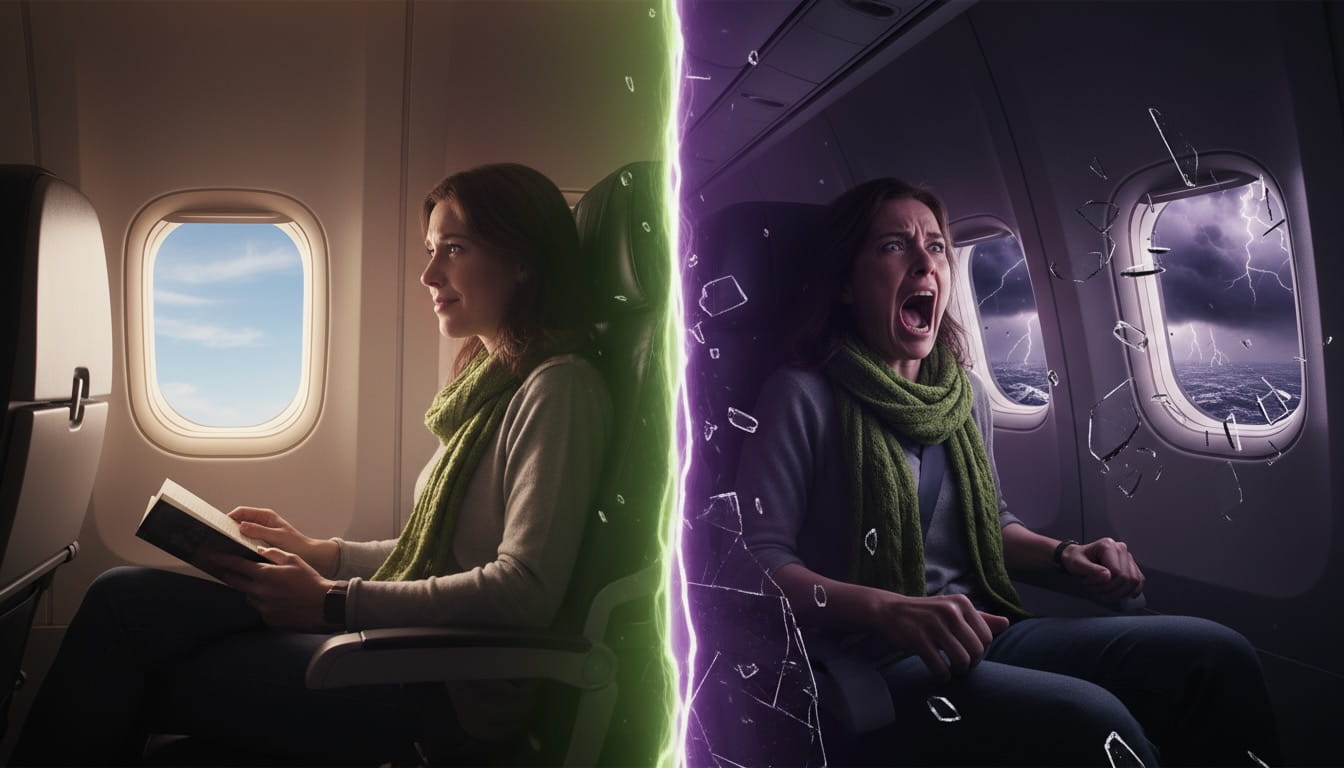
Back when I had anxiety, one thing I struggled with a lot was differentiating what was “real” and what wasn’t.
So today I want to talk a little bit about facts and fiction, because as you may know by now, anxiety always comes with a story. Later on, I’ll also share how to challenge these stories.
The stories or narratives we believe in play a big part in the type of emotions we feel.
You and I can both see the exact same thing, but feel completely different about it. That’s because we both choose a different meaning for the same event.
There’s this saying that nothing in life is essentially ‘positive’ or ‘negative’. It just is. And we decide whether or not it’s positive or negative.
I always found that hard to digest, because it always immediately makes me think of losing my mother and stepdad in a car crash. How could that ever be a positive thing?
And what I realized is that I would never see it as a ‘positive’ thing completely, BUT, a lot of positive things have come out of it. Similarly, many people who recover from anxiety and reflect on it end up saying that a lot of good came out of such a ‘bad’ thing.
We choose the meaning. It can change over time – with experience – but it can also be done the moment we become aware of it. We can do that consciously.
And this is a big part of the response we teach that leads to recovery.
Here are a couple of examples that you may resonate with, illustrating the difference between the event/situation as it is – and the story we create around it that fuels our anxiety.
Fact:
You’re in an airplane and you can’t get out.
Fiction:
- When anxiety shows up, I need to leave.
- Airplanes are dangerous.
- They crash all the time.
- If I panic now, everyone will look at me.
Fact:
You wake up at 3am with a panic attack, unable to sleep.
Fiction:
- This is a sign something is wrong.
- If I don’t sleep, I’ll die / go crazy / get sick.
- I NEED to fall asleep immediately, otherwise X happens.
Fact:
Your heart starts racing and there’s increased pressure on your chest – even though medical professionals ran tests and declared your heart healthy.
Fiction:
- This means the doctor missed something!
- My heart can’t handle this much.
- I need to immediately do something to return to safety.
Do you resonate with some of these examples? I sure do.
In fact, I used to believe all of these stories myself and kept engaging in it. You could throw all the evidence my way – but I’d be stubborn and still believe I’d be the exception or this particular plane would crash.
Why did I do that? More importantly; why do you do that?
Because when you’re sensitized, it’s your brain’s job to highlight potential danger and keep you safe.
I never understood this until I started recovering, and then it made complete sense.
Because I had been reconfirming danger to my brain and nervous system for a long time, it went into ‘high alert’ mode. In ‘high alert’ mode, it would make sure I’d be aware of all kinds of potential threats so I could do something about that.
Even though these potential threats were very unlikely. Sometimes even impossible.
Turns out, it was my job to respond to these stories. To qualify them, so to speak.
I could either engage with it, confirming the alarm – or see it for what it truly was and decide to deal with it in a different way.
This is something that myself and Mirka, one of our mentors, talked about in a live Q&A. We discussed how suddenly we can get existential thoughts and start fearing things we never did before and how we sometimes believe that our anxiety is different or worse than others. You can check that out on YouTube or on Spotify.
How to deal with these stories?
As I said, a big part of the skill that is responding properly to anxiety is recognizing the stories your brain comes up with and crush them.
We need to challenge these stories and correct or remind ourselves that they are not true or skewed / distorted, so we can stop the build up of anxiety.
The more we engage with these thoughts or feelings, the more we confirm the story and the more it’s firing up our body’s protection mechanism. These stories literally fuel anxiety.
If you know a little bit about the response, you know that ‘acceptance’ is a big part of it. It’s to say; “This is happening right now. I don’t like it, but I can’t do anything about it – so might as well let the wave pass”.
Sounds easy, right? Well – this is actually where most people get stuck: they don’t work on their stories.
They only focus on the accepting part, which is actually very hard to do.
Think about it. If you still believe you can die from panic – or that if you don’t do a breathing exercise you will go crazy – you’re never going to allow or accept that to happen.
That’s not what responding properly is.
Responding properly is becoming aware of anxiety itself being present. Whether it’d be in the form of physical sensations or anxious thoughts, you catch it showing up and decide not to engage in the stories it throws at you.
You recognize the stories are there to protect you, but they aren’t accurate. And you understand it’s your job to respond to them and show your nervous system that you’re safe.
So prior to allowing anxiety to be, you want to disarm the story.
These are some of the best ways to do that:
- Educate yourself
By far, the most important and powerful thing to crush the stories your anxious mind comes up with is to educate yourself around the facts.
There are so many misconceptions around anxiety which just aren’t true. If you truly understand how your body works, and how the survival mechanism works, you can remind yourself of that in moments anxiety shows up. You can remind yourself that anxiety, while extremely unpleasant, is harmless.
- Saying “So What!”
I absolutely loved this. Whenever I had a “what if?” question I’d respond with “so what” followed by a fact or a reminder.
“So what, it’s just nervous energy!”, or “So what, if it happens we’ll deal with it then”.
- Asking yourself: is it helpful?
‘ChatGPT, is there a chance that a meteor from outer space falls onto my head right now?’
Yes, sh*t, there is.
Is it productive for me to worry about that 24/7 or should I direct my focus elsewhere? You tell me.
There are a few other techniques to use to disarm these anxious stories that we teach the participants in our program, so they’re armed with a “tool belt” of ways to disarm these time bombs our anxious brains throw at us.
Obviously, we don’t challenge these thoughts to make them go away or because we don’t want to feel anxiety. We do it because it helps us respond properly. It helps our body to carry the nervous energy out of your system the quickest and most natural way.
To bring this home I’d like to give you a couple of examples of these.
Story:
“What if this time my heart will actually stop beating?”
Response:
That’s not going to happen. I’ve been checked out, my heart’s a strong muscle. In fact, it’s my survival mechanism that’s making my heart beat so it won’t kill me. It’s trying to keep me safe instead!
Story:
“What if I get a panic attack and have to leave the meeting room while everyone notices?”
Response:
So what! People leave all the time. I’ll inform them later. They probably won’t think much of it just like I don’t if someone does. Plus, I don’t have to leave – I can ride the wave of anxiety during the meeting. There’s no need to run.
Story:
“What if this new symptom isn’t anxiety but a sign something’s really wrong with my health?”
Response:
I’ve learned that symptoms change over time, and anxiety can manifest in 100+ ways. I can’t do much about it right now, so I’ll assume it’s anxiety and respond. If after a few hours or so I still want to, I’ll call my doctor and get a test done.
A little bit on health anxiety:
Special note around that last example. A lot of people with health anxiety ask me; “How do I know it’s anxiety, and not something else?”.
That makes a lot of sense because anxiety can manifest in so many different ways that could also be signs of something else.
The one thing you always want to do is get yourself checked by a medical professional to rule out anything else. This is the evidence you can use to disarm your stories.
Knowing anxiety, it will convince you that the doctors have missed something – or this time it’s different. Catch and disarm that, and practice your response.
Because what you often see is that, when responding properly, the symptoms or sensations fade away over time. And that’s your proof that it was anxiety all along. And that proof really helps you disarm the next time this story comes up.
So, to summarize:
Remember that we create meaning around situations and events. That meaning may not always be helpful and can be adjusted.
This can happen automatically over time – but can also happen consciously in the moment.
Get better at becoming aware of the stories your mind comes up with, and ask yourself “is it helpful? Is it true? Is it possible?”.
You’ll find that most things aren’t.
Even if they’re possible, it’s just very unlikely and you can decide to shift your energy and focus elsewhere.
Educate yourself around what anxiety is and how it works. That’s the best thing you can do and is the first step towards healing.
Disarm these stories the moment you become aware of them.
Then, ride out the anxiety wave.
And repeat.