
Humor me for a second.
What if you’d imagine this nasty, scary thing we call anxiety not as the problem – but as a “guard dog” that alerts you to an underlying problem? Something that may have been going on for a while?
In my group call last week I had a conversation with Brandon and Steve about some behavior we often see in people with anxiety, like perfectionism or people pleasing.
Coincidentally that same week, one of our other mentors, ‘The Magnificent Mirka’, reflected on the anxiety journey and on how it actually helps us “learn the lesson we didn’t know we needed”.
Because if something is going on underneath the surface – that we may not recognize or are doing something about – anxiety can be the catalyst to ‘cure’ that.
Much like how sickness is the body’s way of healing itself. It’s uncomfortable, but when there’s too much “imbalance”, a balance may be forced.
Today, I’m going to talk a little about that.
What are some things that anxiety brings to light, that you may or may not be aware of, and want/need to change?
Note: it’s important to realize that working on these things isn’t how we get ourselves out of the anxiety cycle, as that’s done by responding. But sometimes it can help to see what brought us into the cycle in the first place – and use this learning to shift our lives to that next stage.
Life Events & Stressors
In life, we’re going to go through events that can cause stress. That’s part of life. Things like loss, divorce, financial worries or trauma.
How we deal with them, though, can be quite random like the roll of a dice.
Because often, we don’t know how to deal with these stressors or events. So our brain will develop patterns or coping strategies to help us. We are either lucky if it developed good ones – or not so lucky if we developed unproductive ones.
Understanding the patterns that don’t serve you can be very helpful in your recovery journey, as they can keep our “stress bucket” filled up, keeping us in this high stress state.
Even if you know how to respond to anxiety and the fear of fear is no longer a problem, we still don’t want to live a life where we unnecessarily keep the nervous system slightly “on”.
By the way, if you don’t know what I mean with the “stress bucket”, check out this short YouTube video that explains this analogy. It may make a lot of sense on why anxiety showed up in the first place and why it keeps showing up.
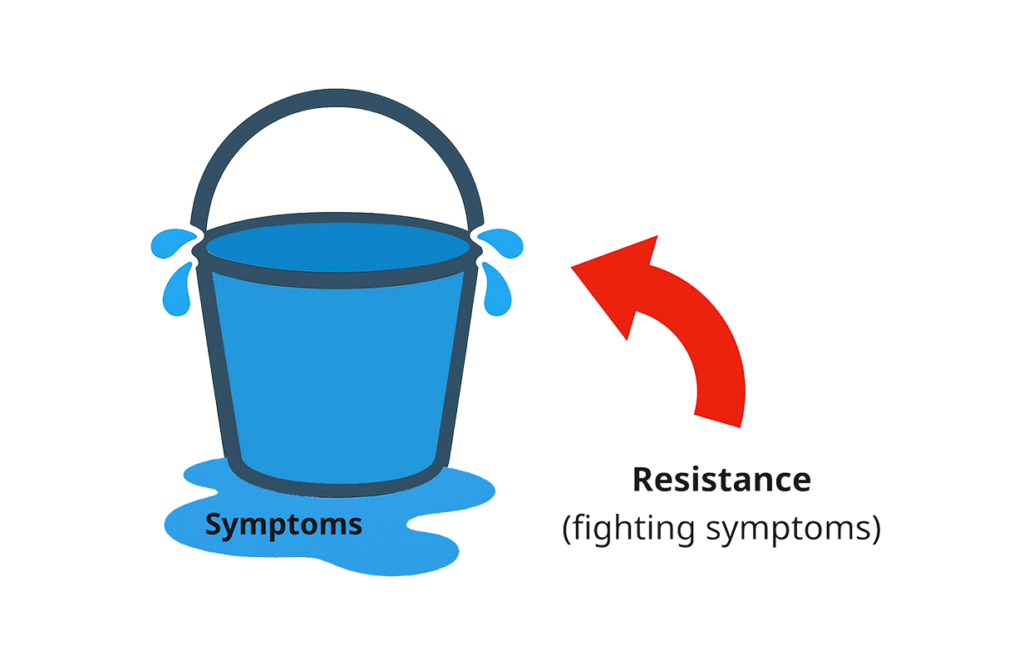
What I want you to understand is that you aren’t simply “this way”.
Life isn’t cause and effect. There’s correlation, but in the end we can direct and choose what we do next. Look up Adler Psychology or Teleology – it’s very interesting!
That’s why I want you to learn about four unproductive meta patterns we often see in people with anxiety – and I want to ask you to identify for yourself which ones you engage in.
As you know, awareness is always the first step towards change.
4 Unproductive Meta Patterns
The first one is one you will surely recognize.
- Avoidance.
It’s the most common one in people with anxiety.
And it’s only natural. When we experience something overwhelming or painful, the brain will learn to make sure we avoid that from happening again.
That actually makes sense, doesn’t it?
For example, when you’ve been through a burnout, you may avoid challenges – or stress entirely.
To avoid conflict or rejection, we may develop patterns of pleasing people.
Or when there’s been a health scare in your life, you may start to avoid certain foods or even medical appointments out of fear of getting bad news again.
The one we all know is avoidance after a panic or anxiety attack. If it happens on the highways, we avoid those. If it happens while on our own, we avoid being alone, etc.
What is the trade-off in this behavior?
We get short-term relief and comfort for long-term growth. In the case of avoiding anxiety, the long term result is sensitization. We keep the nervous system alerted.
- Over-Control.
This is something I recognize a lot within myself. It’s the need for control – for certainty. It often develops after trauma or unpredictability.
Specified to anxiety; when all of a sudden you cannot trust your own body any more, we feel like we’re losing control and may automatically start to increase our need for control.
For example, when you have health anxiety you may scan your body a lot, Googling symptoms, or monitoring your heart rate just to get a sense of control over it.
As long as you keep checking, everything is under control.
Or when you’ve experienced sudden loss, like I did when I lost my parents, you may start to constantly plan for worst-case scenarios, or check in on your loved ones all the time.
Right before my first panic attack I actually did this. I made my girlfriend text me every time she got into work or back home. I was scared of a terrorist attack or anything else happening.
I tried to control not losing another loved one so suddenly – and doing so I trained my nervous system to become more alerted.
What is the trade-off in this behavior?
Control makes us feel responsible. It can give us temporary safety or predictability, which can help us relax the nervous system.
However, over time it increases anxiety because you’re trying to control something that cannot be controlled.
It also makes you dependent on things to go right and it rips adventure from your life.
I absolutely love this Tony Robbins quote:
“The quality of your life is in direct proportion to the amount of uncertainty you’re willing to experience”.
Read that again.
We all need certainty – but too much of it makes our life boring and predictable. Think of being in a relationship where you have the same routines every day – and you know exactly what to expect. Doesn’t sound like a passionate one, does it?
We’re having… potatoes! Again!
- Overthinking or Ruminating
Overthinking is obviously a very common one in general. It’s our brains’ need to problem solve, to figure everything out.
And that’s, once again, not a bad thing. Because the brain can often figure a lot of things out.
However – the things our brain can figure out aren’t the things we OVER-think about most of the time.
It’s the things our brain can’t seem to figure out, that we ruminate over.
Think about this: if you have a problem, and you think about it and find the solution, you would just go and apply that solution right?
It’s within overthinking that we somehow believe that thinking about it all the time is the solution. It’s like thinking about death or cancer all the time, as if that would reduce the changes of it happening.
For example, when you’ve done something embarrassing in public (we’ve all been there), we may start to replay that for days.

Or for example after a breakup, we keep analyzing what we did wrong – and trying to identify that one mistake.
With anxiety, it’s researching and analyzing all the time or trying to find the “root cause” of it.
It’s thinking about the next panic attack – as if that’s magically going to make sure it doesn’t happen.
What is the trade-off in this behavior?
The brain believes that thinking about these things protects you from them. It thinks we’re problem solving.
In reality, we’re fueling stress. Because when we can’t find the solution in our brain, we just waste energy and create stress.
- Self-pressure.
This is a sneaky one and extremely common in high achievers (which most people with anxiety are).
It’s the need to perform. To do something. To “fix” this.
This has been very true for me personally, which is why I had to learn about self-compassion in my anxiety recovery journey and I now teach this to others too. I had to realize the hard way that self pressure didn’t actually help me that much.
After developing anxiety, self-pressure may show up in the form of tracking your progress obsessively, or forcing yourself to do “exposure exercises” every day, to recover faster.
Or, if you’ve always been “the strong one”, it’s not allowing yourself to struggle. It’s hiding symptoms or trying to power through. This is common in a lot of people I have spoken to, especially men in the fields of business or law enforcement.
In self-pressure we also find perfectionism. The need to be perfect at everything we do. We talk a lot about perfectionism in my program, as it’s a common trait between us, and it’s often found at the root of the problem too.
Perfectionism is the lowest standard there is, actually. Why? Because when you need to be perfect, you don’t grow. Because growth happens with practice, with trial and error.
Quitting at the first attempt because you’re not perfect at it is the opposite of that.
What is the trade-off in this behavior?
Self pressure looks like discipline, ambition or strength – but there is a trade off.
In the short term it can help us achieve things. It can create drive, momentum and makes us mobilize.
But on the other hand, it can burn us out and even avoid the things we need, like practice or rest. It can actually get in the way of progress, of growth.
It elevates our cortisol levels and keeps us always “on”, turning life into a performance and failure into an identity collapse.
What about you?
I hope these four patterns made sense and I’m sure you can resonate with a couple of them.
Understanding these meta patterns can make you become more aware of them – so you can change them.
Here’s a list of a few common ones per meta pattern that I want you to run though and identify. Which coping patterns do you engage in?
Avoidance:
- People pleasing
- Procrastination
- Conflict avoidance
- Social withdrawal
- Reassurance seeking
Over-control:
- Body scanning
- Over-planning
- Micromanaging
- Needing certainty before acting
- Struggling when plans change
Overthinking / Rumination:
- Replaying conversations
- Googling symptoms for hours
- “What if” thinking
- Searching for the root cause
- Constant self-monitoring
Self-pressure:
- Perfectionism
- Harsh self-criticism
- Guilt when resting
- Workaholism
- “I should be over this by now”
When I was talking to Brandon and Steve last week, we realized that anxiety brought to light a lot of these coping patterns that weren’t helping us.
Steve was talking about how he had been taking on a lot of positions on various boards, and how he actually didn’t want to be on all of them – but worried about letting his friends down.
I remembered how I used to say “yes” to a lot of things I should’ve said “no” to. Or how I tried to force control of not losing another loved one. Or how I’d pressure myself not making any mistakes.
These things can all contribute to the first time we got anxiety symptoms. And it’s anxiety that gives us this hard lesson that we didn’t know we needed.
In order to overcome and stop these patterns, we need to be aware of them. And if anxiety recovery does one thing, it’s making you aware of your patterns – for sure.
Life gets a little easier after recovery, because you’ve learned so much about yourself and your patterns. You’re also no longer sensitized, which is pretty neat, so not everything makes you spiral into Fight or Flight mode any more.
And it makes you look at life from the perspective of:
How do I want to live it?
What are things I will no longer do?
And if you fall back into unproductive habits or patterns (life happens), it’ll be anxiety symptoms making you aware of them.
Then, with you being able to respond properly and not getting trapped any more, you can make a change or find your balance again.
And, for that, anxiety is a good ol’ boy.
Your guard dog.