If you’re like most people with anxiety, you probably have no idea how it came on – and how it’s staying on in your life.
And as long as you don’t, there is no way you’ll be able to break out of it fully.
So it’s an understatement to say that – if that’s you – this may be the most important thing you’ll read today.
Imagine feeling dizzy, nauseous, sweaty – fully on edge, unable to eat, with a racing heart and a tight knot in your stomach.
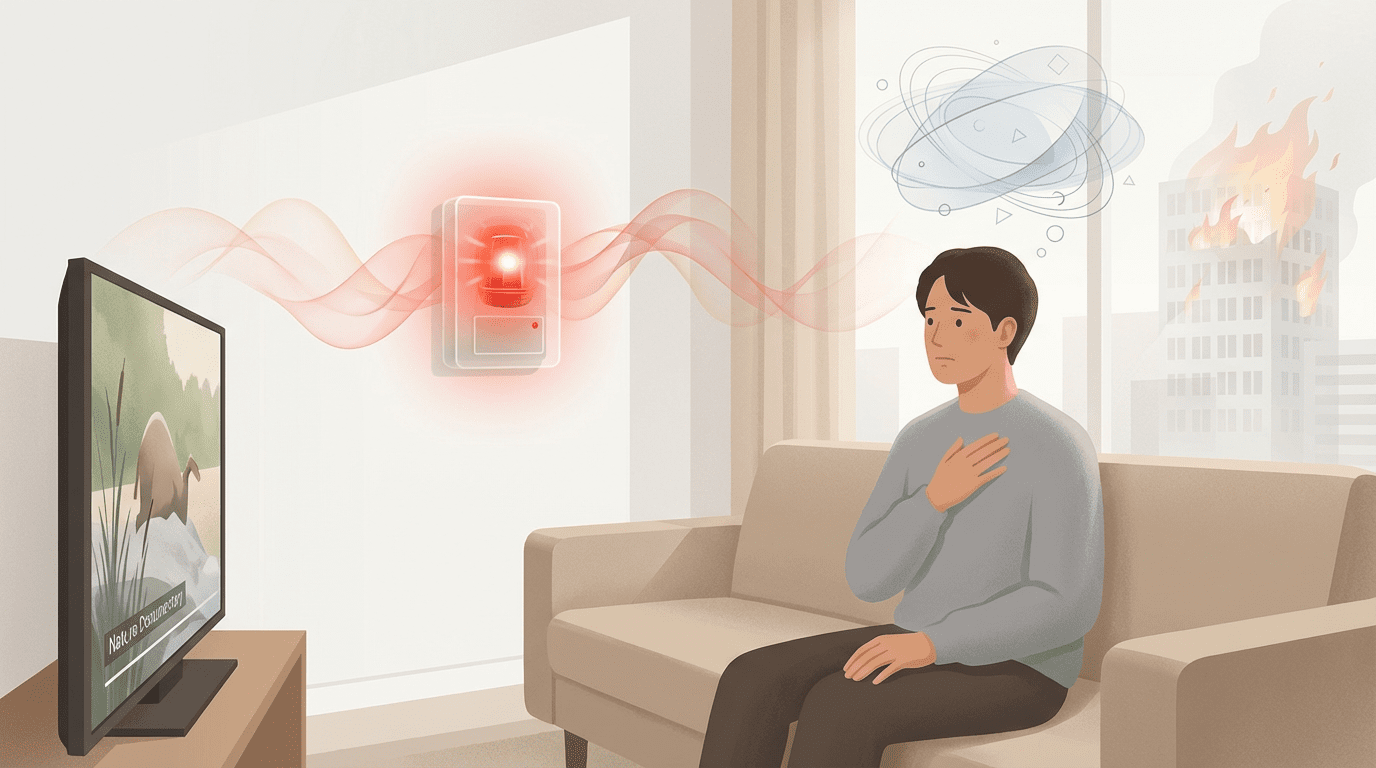
Now imagine you feel that way while standing outside your office building, watching flames burst through the windows: a fire is blazing!
How would you feel about those sensations? Would you doubt them? Or would they make sense to you as, a couple of minutes ago, you were in danger – running out of the building?
I bet you wouldn’t think much of it.
Now, imagine you’re at home watching television and you start to feel the exact same way. But there’s no fire. Nothing is going on.
How would you feel about that?
I’m assuming this may be similar to what happened to you too.
Out of nowhere, you started to feel physical sensations – or other symptoms – and there was no clear danger to tie it to.
Our “Fight or Flight” mechanism triggered, but for no good reason. And this mechanism, these sensations, are so scary that we naturally start looking for reasons why.
“Something must be wrong!”
And this is when two of the three most important factors behind anxiety come at play:
- 1) Misinterpretation
- 2) Catastrophization
Because the Fight or Flight mechanism has been triggered, we feel that there must be a real threat, so we start to misinterpret these symptoms for something worse and we catastrophize a worst-case scenario unfolding.
In my case, when I had my first panic attack, I felt the feeling of extreme nausea and dizziness, and I misinterpreted this for being sick. I catastrophized myself having to throw up in front of all these people.
And this is where the third factor comes into play:
- 3) Behavior.
This catastrophe is so bad that we feel the urge, the need, to do something about it, and make sure it doesn’t happen.
So, we acted on it. Maybe we ran away, sat down, called somebody, etc…
But the catastrophe didn’t happen. We ended up being OK. Phew..!
Sounds familiar? This is what tends to happen on the level of the mind, the conscious, action-based level.
For whatever reason (I won’t go into that now), the fight or flight response was triggered – at random – without any real danger present.
And how we reacted when it did, determined whether or not anxiety would show up again.
To understand this, we need to look at things from the subconscious, the Nervous System level.
When we misinterpreted the harmless Fight or Flight symptoms, mistaken them for a sign that a catastrophe is about to unfold and acted on that, we sent a signal to the nervous system that said;
“We’re in danger!”
And the nervous system will learn. It will try to help you fight off this “danger”, by releasing more chemicals. The same ones that gave you the symptoms in the first place.
So the nervous system has misinterpreted this event, these symptoms and the catastrophe (in my case; vomiting in public) as: danger. Potential Threat. Likely to happen.
And this is when you start to focus on it more. You start to think about it more.
“What if it happens again?”
“What if, next time, I won’t be able to leave?”
We start to catastrophize the panic or anxiety itself happening.
And this increases the nervous energy going through our body on a consistent basis. Basically, your nervous system tightens the sensitivity of the fight or flight mechanism, so it triggers quicker and more often, keeping you on high alert.
And the more you behave as if the danger is real (i.e. the office building is on fire), the more your nervous system is going to send you anxiety symptoms.
This is why anxiety keeps showing up, after that initial moment or period. It’s not because we are broken, but because we are telling our nervous system to keep it coming!
We are keeping anxiety alive. Over and over.
We keep shouting “FIRE!” when the fire alarm goes off falsely, confirming the danger is real where it isn’t.
We misinterpret the anxiety itself for being something worse, and we catastrophize something bad happening. This leads us to behave in accordance to as if there was danger.
Do you see that the symptoms showed up quite randomly, but your behavior and your response to it, triggered the additional anxiety and the recurrence of it?
This is also the good news, because it shows you that you are trapped in a pattern of behavior. A cycle. And to break that cycle you need to:
- Stop misinterpreting what’s happening to you.
Educate yourself around what anxiety is – very unpleasant and scary, but not dangerous. The more you know about this the easier it becomes, so you can label what you feel as anxiety instead of something way worse.
- Challenge the catastrophe and stop it from spiraling.
Dismissing the fantasy and not treating it as if it’s reality or likely to happen. This is something you need to practice over time and this takes courage.
And lastly,
- Behave as if you are safe.
Which you are. The nervous system is watching you, learning that you’re safe, so it will let go as there is no need to “help” you fight off this danger any more.
It goes without saying that before learning and practicing to respond in this way, you should always consult with a doctor to rule out anything else besides anxiety – so we know it’s safe to dismiss what you’re feeling as harmless “false-alarm” energy.
One more important nuance in this is that a lot of behavior that we are taught communicates to the nervous system that we’re in danger. Things you may not even think of directly.
Sure, running away whenever you feel panic or anxiety come up is an obvious one. But doing things like breathing exercises or meditation to get rid of the unpleasant symptoms communicate the same thing, keeping you stuck in a cycle of Fight or Flight.
More sneaky pro-anxiety behavior could be things like drinking water every time you feel anxious, or sitting close to exits, always calling your partner whenever you feel anxious.
All of these things – with the intention to get rid of anxiety – communicate to your nervous system that the danger is real. And it will send you more symptoms to fight off that danger.
Really, the only thing that leads to recovery from anxiety is treating it like that office building that’s on fire, where you can tie it to something and not start catastrophizing about it.
“Oh hey, this is just anxiety. I know it’s harmless energy. It’ll go away once I show my nervous system I’m fine. Let’s continue with my day”.
Maybe it’ll make watching television a bit less pleasant in the moment, but the more you respond correctly, the less anxiety you’re going to get – until the nervous system lets go.
You’ve got this.