
You had a few good days. Maybe even a good week. And then anxiety came back hard, and now you’re sitting there wondering if any of it even counted.
It did. Here’s why.
There’s a moment that almost every single person goes through in recovery, and it’s one of the most dangerous moments if you don’t understand what’s actually happening.
You’ve been making progress, you’ve been doing things you were previously avoiding, you’ve been practicing the response, and things have genuinely felt lighter. And then out of nowhere… BOOM! Anxiety spikes again.
Maybe it’s a stressful week at work, maybe it’s the holidays, maybe there’s no obvious reason at all. And suddenly the thought arrives: “I’m back to square one”.
That thought is BS. And I want to explain exactly why, because misreading a setback is one of the most common reasons people stall in their recovery or give up entirely when they were actually closer than they realised.
What a Setback Actually Is
Here’s the first thing I want you to really sit with: you can only have a “setback” if you’ve made progress.
You cannot fall back unless you’ve moved forward first. People who are completely stuck in the anxiety cycle don’t have setbacks, they just stay stuck. They never leave the loop. But you did, and that’s the whole point!
So in a strange way, a setback is actually a sign that something has shifted. It means you’ve advanced far enough that there’s ground to feel like you’ve lost. And that matters more than it might feel like right now.
What’s happening physiologically is also worth understanding. Your nervous system has been desensitizing through everything you’ve been doing, and as it releases old stored stress, it can trigger a wave of symptoms that feels almost identical to the early days.
Sometimes it throws something new and unfamiliar at you, a new sensation, a thought you haven’t had before, a wave of panic that seems to come from nowhere. And your survival brain (doing exactly what it was designed to do) uses this as an opportunity to test whether the threat is real.
It’s watching how you respond. That’s really all this is.
This is why I sometimes think the word “setback” doesn’t quite capture what’s actually happening.
It sounds like regression, like you’ve lost something. But what it really is, is like a “final exam”. Your nervous system is checking whether you are really safe, and depending on how you handle it, you’re about to grow even more than you did during the good stretch.
Why It Feels Like Square One
I get why it feels that way though, and I want to acknowledge that properly because the feeling is genuinely cruel in a very specific way.
When anxiety spikes after a period of feeling better, it hits differently than it did at the beginning.
Because now you know what it feels like on the other side, the contrast is sharper, and the fear of losing that progress becomes its own layer of anxiety sitting on top of the original anxiety.
Does that sound familiar? Like Cindy in our group call on Thursday, worrying whether or not anxiety may come back after a week of calm.
The brain starts doing what anxious brains do: “Was my improvement even real? Am I back to the beginning? Does this even work?”.
And that spiral, if you let it run, is actually what prolongs the setback far more than the spike itself ever would have.
This is the trap that catches so many people. The setback itself isn’t the problem. The response to the setback is what determines how long it lasts and how much ground you actually lose.
If you respond the way you used to before you understood any of this, by fighting the sensations, by catastrophising what they mean, by concluding you’re broken again, by retreating from the things you’d started doing, the spike gets fuel.
Your nervous system reads that response and decides the threat must be real, and it stays on guard accordingly. What could have been a few difficult days stretches into weeks because the response keeps feeding it.
If you respond the way you’ve been learning to respond, by acknowledging it, allowing it, not making it mean anything catastrophic, and carrying on with what you were doing, the spike does what spikes do when they stop getting rewarded. It passes.
The Two-Steps-Forward-One-Step-Back Reality
Recovery from anxiety is genuinely not linear, and I want to be honest about that rather than paint a picture that sets you up for exactly this kind of disappointment.
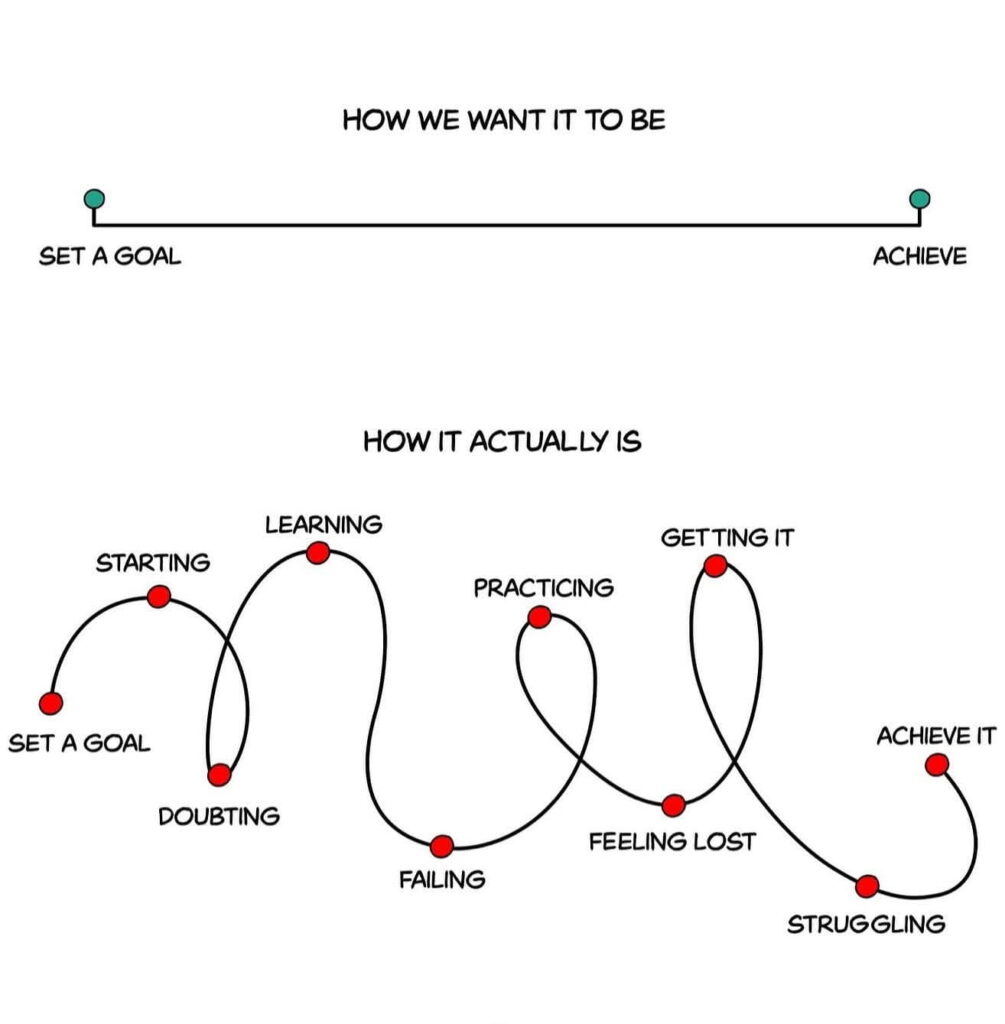
What it actually looks like for most people is a general upward trend with dips along the way. You have a breakthrough week where you do something you haven’t done in years, and then anxiety creeps back and it feels like you’ve lost everything, and then you have another good stretch, longer this time, and then another dip, but shallower than the last.
Sounds, fun – doesn’t it…?
BUT, slowly, over weeks or months, the good periods get longer and the difficult periods get shorter and less intense. The baseline shifts, even when it’s hard to see from inside a dip.
And that’s the problem with setbacks. When you’re in one, you can’t see the overall trend. You’re just in it, and the brain being the threat-detection machine it is, focuses entirely on the current data point, which is that this feels bad again. It discounts everything that came before and concludes the worst.
This is why looking back honestly across weeks and months matters more than how today feels.
This is why we encourage our members to share wins and celebrate them. Capture them and read back through it so remind yourself how far you’ve actually come.
When you continue responding, you’ll see that the spikes are less frequent than they were. The recovery time between difficult periods is shorter.
The things you’re doing now compared to six months ago are genuinely different. That’s the data that actually tells you where you are in recovery, not how a Tuesday afternoon feels when the anxiety is high.
What to Actually Do During a Setback
The answer here is the same as it always is, and I know that can feel frustrating to hear when you’re in the middle of it.
You respond properly. You don’t fight the setback, you don’t conclude that everything is lost, and you don’t retreat back into the smaller life you’d started climbing out of. You catch yourself engaging in a story, and decide not to. You “falling back” is just a story, because it actually is part of the whole recovery journey. It’s to be expected.
So, you allow the sensations without treating them as catastrophic, and you carry on as best you can with what you had planned. Catch, correct, refocus – my dear courageous friends.
One of the most important things is to not shrink your life back down during a setback. The instinct is to pull back, to stop doing the things you’d started doing, to protect yourself from situations that might trigger more anxiety.
But that instinct will make the setback worse and longer, because avoidance always does. Keep going to the places you’ve been going. Keep doing the things you’ve been doing.
Every time you show up to a difficult situation during a setback and come through the other side, you’re adding another piece of evidence to the bank, evidence that you can handle this, that the sensations don’t stop you, that the spike is survivable.
Stack da proof, man!
And don’t go looking for a new solution. This is something I see a lot, where people hit a setback and immediately start searching for something they must have missed, a new technique, a new theory, a new program.
The answer isn’t out there. The answer is to keep doing what you’ve been doing, consistently, and to give it time.
Let me repeat those two words in case you quickly read over it.
TIME and CONSISTENCY!!!
That’s what you need. Well… plus responding properly – of course.
You’re Further Along Than You Think
The fact that you’re having a setback means you had progress to set back from, and that progress doesn’t disappear because anxiety showed up again for a few days.
The understanding you’ve built, the wins you’ve accumulated, the moments where you chose to respond differently instead of running, none of that gets erased by a difficult week.
Recovery isn’t about reaching a place where anxiety never shows up again. It’s about reaching a place where it showing up doesn’t mean anything anymore, where you can feel the spike, recognize it for what it is, respond to it properly, and carry on with your day without it turning into a crisis.
And every setback you navigate without retreating is genuinely making you better at exactly that.
It’s another rep. And the most powerful ‘reps’ you can do in anxiety recovery are the ones you didn’t expect. The new ones. The intense ones.
If you can get back up after that unexpected punch, you’re so much closer to not giving a F-ing F about anxiety. And that’s what sets you free.
There’s a version of you on the other side of enough of these that doesn’t fear new symptoms anymore. That stops asking “will this ever happen again?” and starts landing on “if it does, so what?”.
That’s real freedom. And setbacks, uncomfortable as they are, are how you get there.
You’re not back to square one.
You’re at the stage right before freedom. And I’ve seen it happen over and over: the people who go through this stage, recover shortly after.
Keep going.